
Form 3CEB Missed on 31 October? The ₹1 Lakh Penalty Is Not Automatic
The 31 October date for Form 3CEB has passed, and CBDT did not extend it for transfer-pricing cases. If your company has an NRI promoter, a foreign parent or a group entity abroad, the question now is how much the delay can cost and what to do before the return falls due on 30 November.
The ₹1,00,000 figure most people quote is real, but it comes with two conditions that decide whether it is ever charged.
Quick answer: For AY 2026-27, Form 3CEB was due on 31 October 2026 and CBDT did not extend it. Late filing exposes you to a penalty of ₹1,00,000 under section 271BA, which the Assessing Officer may direct and which section 273B removes if you prove reasonable cause. File the report now. From tax year 2026-27 the form is Form 48 under section 172, and the penalty becomes a tiered fee under section 428(d).

Contents
Was Form 3CEB extended? The dates that apply
No. CBDT Circular No. 07/2026, dated 28 September 2026, moved the AY 2026-27 return date from 31 October to 21 November, but only for persons at serial no. 2 of the table below Explanation 2 to section 139(1). It moved the tax audit report date to 21 October as a consequence.
A person who must furnish a report under section 92E sits at serial no. 1, and the circular does not mention it. Their return stays at 30 November, so their report stays at 31 October.

Filing | Who | Date for AY 2026-27 |
|---|---|---|
Form 3CEB, section 92E | Any person with an international transaction or a specified domestic transaction above ₹20 crore | 31 October 2026 (not extended) |
Tax audit report | Audit cases that also fall under section 92E | 31 October 2026 |
Tax audit report | Audit cases without section 92E | 21 October 2026 (extended) |
Return of income | Section 92E cases | 30 November 2026 |
Return of income | Audit cases without section 92E | 21 November 2026 (extended) |
The tax audit row for section 92E cases follows from section 44AB: the report is due one month before the return due date, and the circular itself relies on that rule. Our tax audit due date post covers the ordinary audit calendar, and the pre-deadline Form 3CEB post covers applicability.
Which NRI or foreign links make you a Form 3CEB filer?
Form 3CEB is not only for large multinationals. It is triggered by an international transaction: a transaction between two associated enterprises, at least one of which is a non-resident. Value is no test for international transactions, so a single loan or service fee can bring a company in.
Association is the first question. Section 92A (section 162 of the 2025 Act) treats two enterprises as associated in cases such as these:
One enterprise holds 26% or more of the voting power in the other, or one person holds 26% or more in both.
One enterprise has lent 51% or more of the book value of the other's total assets.
One enterprise guarantees 10% or more of the other's total borrowings.
More than half of the board, or an executive director, is appointed by the other enterprise or by a common person.
The business is wholly dependent on know-how or brands of the other, or 90% or more of raw materials come from it on influenced terms.
A founder who lives in Dubai and holds 26% or more of an Indian company will usually make the company and his other businesses associated enterprises. Then loans from him, purchases from his foreign company and fees to it are all in scope. The test for the loan terms is in our intercompany loan post.
Section 92B(2) (section 163(2) of the 2025 Act) goes further: a transaction with an unconnected party can be deemed international if a prior agreement or the substance of its terms is fixed between that party and an associated enterprise.
Worked example: an NRI-promoted company that missed 31 October
The figures are illustrative. Kaveri Components Pvt Ltd (a made-up company) has an NRI founder, Rohan, in Dubai who holds 45% of its voting shares and owns 100% of Gulf Trading FZE in the UAE. In FY 2025-26 the company has these dealings:
Transaction with Rohan or Gulf Trading FZE | Amount |
|---|---|
Components purchased from Gulf Trading FZE | ₹1,80,00,000 |
Management fee paid to Gulf Trading FZE | ₹40,00,000 |
Loan from Rohan (interest paid ₹13,50,000 at 9%) | ₹1,50,00,000 |
Aggregate of international transactions | ₹3,70,00,000 |
All three are international transactions, so section 92E applies, and the aggregate is above the ₹1 crore point where Rule 10D documentation becomes mandatory. The company's tax audit report also falls due on 31 October, not 21 October.
On 3 November the company finds that the CA uploaded Form 3CEB on 30 October, but nobody approved it in the taxpayer's worklist. It is still pending, so the report is treated as not yet furnished.
Best case: the company approves and verifies it on 4 November, keeps the portal screenshots and a note of the reason, and answers any notice with a section 273B reasonable-cause explanation. Exposure: ₹1,00,000 at most, and possibly nil.
Worst case: nothing is filed and no Rule 10D file exists. Section 271BA is ₹1,00,000. Section 271AA(1) can add 2% of each transaction: ₹3,60,000 on purchases, ₹80,000 on the fee and, if the officer takes the principal as the value of the loan, ₹3,00,000. That is ₹7,40,000 plus ₹1,00,000, or ₹8,40,000.
The worst case is a ceiling for a file with no records at all, not a forecast. The point is that the late report is the smaller exposure, and the missing documentation is the larger one.
Practice guide for professionals
Amended Form 3CD: A Practical Guide (₹299) works clause by clause through the tax audit report, including the transfer-pricing disclosures that sit beside Form 3CEB. The ₹699 bundle has all four practice guides.
What is the penalty, and is it automatic?
Section 271BA says that if a person fails to furnish the report required by section 92E, the Assessing Officer may direct that he pay ₹1,00,000. The word is "may". It is a fixed sum, so the amount does not depend on the size of the transactions.
Section 273B then says that no penalty is imposable under sections 271AA, 271BA or 271G if the person proves there was a reasonable cause for the failure. The burden is on you, so the evidence has to be contemporaneous.
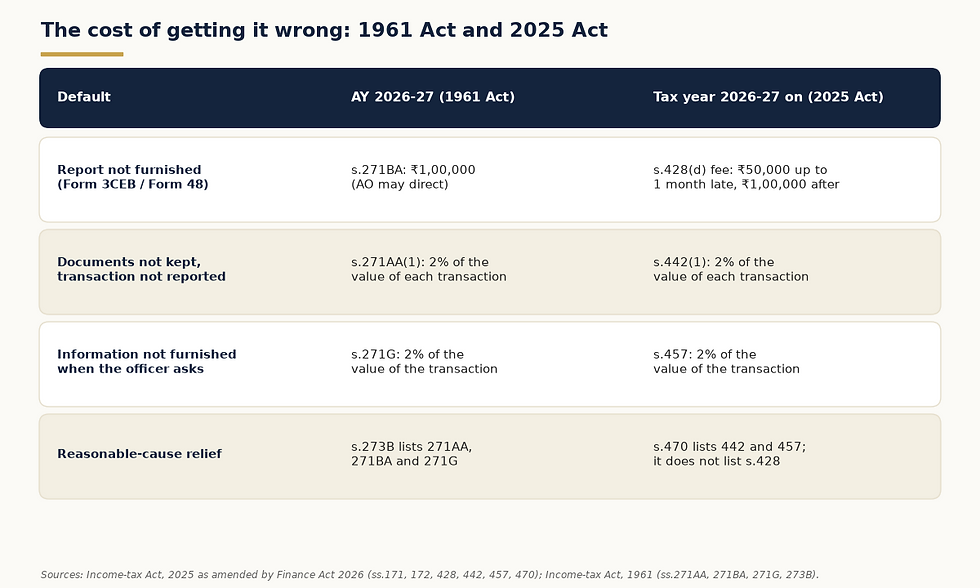
Late filing is not the only transfer-pricing penalty. Section 271AA(1) and section 271G charge 2% of the transaction value for missing documents, unreported transactions, incorrect information or information not furnished on the officer's request.
Checklist: what to do now
Confirm applicability: list every transaction with a foreign promoter, parent or group company, and test association under section 92A. Specified domestic transactions count only above ₹20 crore in aggregate.
Check the portal status for AY 2026-27: Pending for Upload, Pending for Acceptance, or filed. The form is complete only after the taxpayer approves and verifies it.
File the report now. Do not wait for the return, and do not file a report with unreconciled numbers just to close the status.
Write down why it was late, the same day: dates, DSC or portal problems, who was waiting for what. Keep screenshots and emails.
Build or complete the Rule 10D file for each transaction. The documentation post lists the contents.
Reconcile the report with the books and the transfer-pricing details in the return, due 30 November for section 92E cases.
If a penalty notice arrives, reply within the date given, plead section 273B, and attach the evidence.
From tax year 2026-27: Form 48, section 172 and the new fee
The Income-tax Act, 2025 applies from tax year 2026-27, so AY 2026-27 is the last year for Form 3CEB. The new form is Form No. 48, furnished under section 172, and Rule 85 of the Income-tax Rules, 2026 replaces Rule 10E.
Rule 85 requires it at least one month before the return due date under section 263(1). Section 173(d) carries the old definition of the specified date.
The default consequence changes in character. Section 447 was omitted with effect from 1 April 2026. In its place section 428(d) charges a fee:
₹50,000 if the report is up to one month late.
₹1,00,000 if the delay goes beyond one month.
Section 470 gives the reasonable-cause shield to the penalty sections it names, including 442 and 457, but section 428 is not among them. Read against the text, a fee under section 428(d) may not have that shield, so plan to file on time. The same section also charges ₹75,000 or ₹1,50,000 for a missed audit report under section 63 (section 428(c)).
Common mistakes
Treating 30 November as the Form 3CEB date. It is the return date for section 92E cases.
Assuming the 21 October and 21 November relief covers transfer-pricing cases. It does not.
Counting a CA upload as filing. The taxpayer's approval and verification complete it.
Leaving out NRI-promoter loans because they are "only FEMA". They are reported if the lender is an associated enterprise, even where no adjustment is expected.
Reporting only profit and loss items. Closing balances, reimbursements and guarantees can be international transactions too.
Keeping the Rule 10D file for later. The 2% penalty is on each transaction, so a missing file costs more than a late form.
Assuming the 2025 Act's reasonable-cause section protects the new fee. Check the text before relying on it.
Practitioner insight
The date trap is not the report itself. It is that the audit-case relief looks like a general relief, and a company with a foreign promoter is easily treated as an ordinary audit case.
A practical habit for advisors is to keep a short associated-enterprise register for each client with NRI or foreign shareholders, updated in April. Assign the form on the portal by mid-October, and check the taxpayer approval step with a named person.
The cheaper insurance is a signed Rule 10D file in hand by the specified date, with the report matching the books. That is what a notice will ask for first.
Old and new section map
Topic | Income-tax Act, 1961 (to AY 2026-27) | Income-tax Act, 2025 (tax year 2026-27 on) |
|---|---|---|
Accountant's report on international and specified domestic transactions | Section 92E, Rule 10E, Form 3CEB | Section 172, Rule 85, Form 48 |
Specified date for the report | Section 92F(iv) | Section 173(d) |
Associated enterprise | Section 92A | Section 162 |
International transaction | Section 92B | Section 163 |
Specified domestic transaction (above ₹20 crore) | Section 92BA | Section 164 |
Information and documents to be kept | Section 92D, Rule 10D | Section 171 |
Failure to furnish the report | Section 271BA, ₹1,00,000 | Section 428(d) fee, ₹50,000 or ₹1,00,000 (section 447 omitted) |
Failure to keep documents or report a transaction | Section 271AA(1), 2% | Section 442(1), 2% |
Failure to furnish information on request | Section 271G, 2% | Section 457, 2% |
Section 273B | Section 470 |
Frequently asked questions
What was the Form 3CEB due date for AY 2026-27?
31 October 2026, a Saturday. The report under section 92E is due one month before the return due date, and for section 92E cases the return is due on 30 November 2026. It was not extended.
Did CBDT Circular 07/2026 extend Form 3CEB?
No. The circular of 28 September 2026 extended only the return due date for persons at serial no. 2 of the table below Explanation 2 to section 139(1), from 31 October to 21 November, and with it the tax audit report date to 21 October. Section 92E cases are not in that serial number.
What is the penalty if Form 3CEB is filed late?
Section 271BA provides a penalty of ₹1,00,000 where a person fails to furnish the report required by section 92E. The Assessing Officer may direct it, so it is not automatic, and section 273B bars the penalty if the person proves reasonable cause for the failure.
Is filing the report on the portal enough, or does the taxpayer have to do something?
On the e-filing portal the CA uploads the form, but it then waits in the taxpayer's worklist under For your action. As per the portal's Form 3CEB FAQs, the filing is complete only after the taxpayer approves and verifies it.
Is a loan from an NRI relative reported in Form 3CEB?
Only if the lender and the borrower are associated enterprises, for example the lender holds 26% or more of the voting power or has funded 51% or more of the borrower's total assets. A loan between two unconnected persons is not an international transaction, so test the association first.
What replaces Form 3CEB under the Income-tax Act, 2025?
Form No. 48, furnished under section 172 and Rule 85 of the Income-tax Rules, 2026, for tax year 2026-27 onwards. It is due one month before the return due date under section 263(1), as section 173(d) defines the specified date.
Does the same ₹1,00,000 penalty apply under the 2025 Act?
The penalty section 447 was omitted from 1 April 2026. Section 428(d) now charges a fee of ₹50,000 if the report is up to one month late and ₹1,00,000 after that. Section 470, the reasonable-cause section, lists sections 442 and 457 but not section 428.
Related reading
Sources and scope
Income-tax Act, 1961: sections 44AB, 92A, 92B, 92BA, 92D, 92E, 92F, 139(1), 271AA, 271BA, 271G and 273B; Income-tax Act, 2025 as amended by Finance Act 2026: sections 162, 163, 164, 171, 172, 173, 428, 442, 447 (omitted), 457 and 470; Income-tax Rules, 2026: Rule 85 and Form 48 (Income Tax Department Form 48 FAQs); CBDT Circular No. 07/2026 dated 28 September 2026 and PIB release of the same date; e-filing portal FAQs for Form 3CEB. Figures are illustrative. Educational content only, reflecting the law as of 6 November 2026; check the current law and your facts.
Guides and toolkits
Practice guides at ₹299 each, or ₹699 for all four.
This is an educational publication for professionals. It is not an offer of professional services.


Comments